
Beyond the Grand Slam
Extraordinary expeditions to the most remote places on the planet
The exploration continues
After completing the Grand Slam of travel—193 countries, both poles, and space—curiosity doesn't stop. These are journeys to places where few human beings have reached, where nature still dominates, and where each expedition reveals something new about the world and about oneself.
Oymyakon: the coldest inhabited place on Earth
Siberia, Russia · 2026
The journey begins
I'm sitting on the plane from Istanbul to Bogotá after more than thirty hours of travel. Just a few days ago I was walking at −51°C in Oymyakon, Siberia, the coldest inhabited place on the planet. The contrast is absurd even to me.
The return journey has been truly brutal. First, twenty-two hours by car from Oymyakon to Yakutsk, with two stops to sleep along the way. Then a seven-hour flight to Moscow. After that, another four-hour flight to Istanbul. And finally the long stretch: Istanbul–Bogotá–Panama, more than eighteen hours inside the plane.
You have to be a little crazy to do something like this. But there are also places in the world that awaken a curiosity that's hard to explain. Oymyakon is one of them.

The coldest inhabited place
This small village in the remote Russian republic of Yakutia is considered the coldest inhabited place on the planet. In 1933, a temperature of −67.7°C was recorded there, the official record for a permanent human settlement. During winter, temperatures close to −50°C are part of daily life.
It's one of those places that many people have heard of, but very few have seen with their own eyes.
Four Grand Masters
In one of the most memorable photos from the trip, I'm standing next to Johnny Ward, the famous Irish traveler. Johnny is known in the world of great travelers for having visited every country on the planet. His story has received considerable attention in exploration and adventure circles—in fact, CNN interviewed him in 2024.
On this expedition, four "Grand Masters" coincided, as those who have managed to visit every country in the world are informally known. Among us there are also some interesting curiosities. Johnny has climbed the highest mountain on each continent. I have been to space. We have both also been to both poles of the planet.


The Road of Bones
Getting to Oymyakon means crossing one of the most remote regions of Siberia. Access is from Yakutsk following the famous Kolyma Highway, popularly known as the Road of Bones.
The name is no coincidence. During Stalin's era, thousands of gulag prisoners were forced to build this road under brutal conditions. Many died during the work and local history says their bodies were buried under the road itself.
Today the road crosses an immense and silent tundra where human presence is minimal. It's a landscape of frozen forests, motionless rivers, and endless horizons.
−51°C at noon
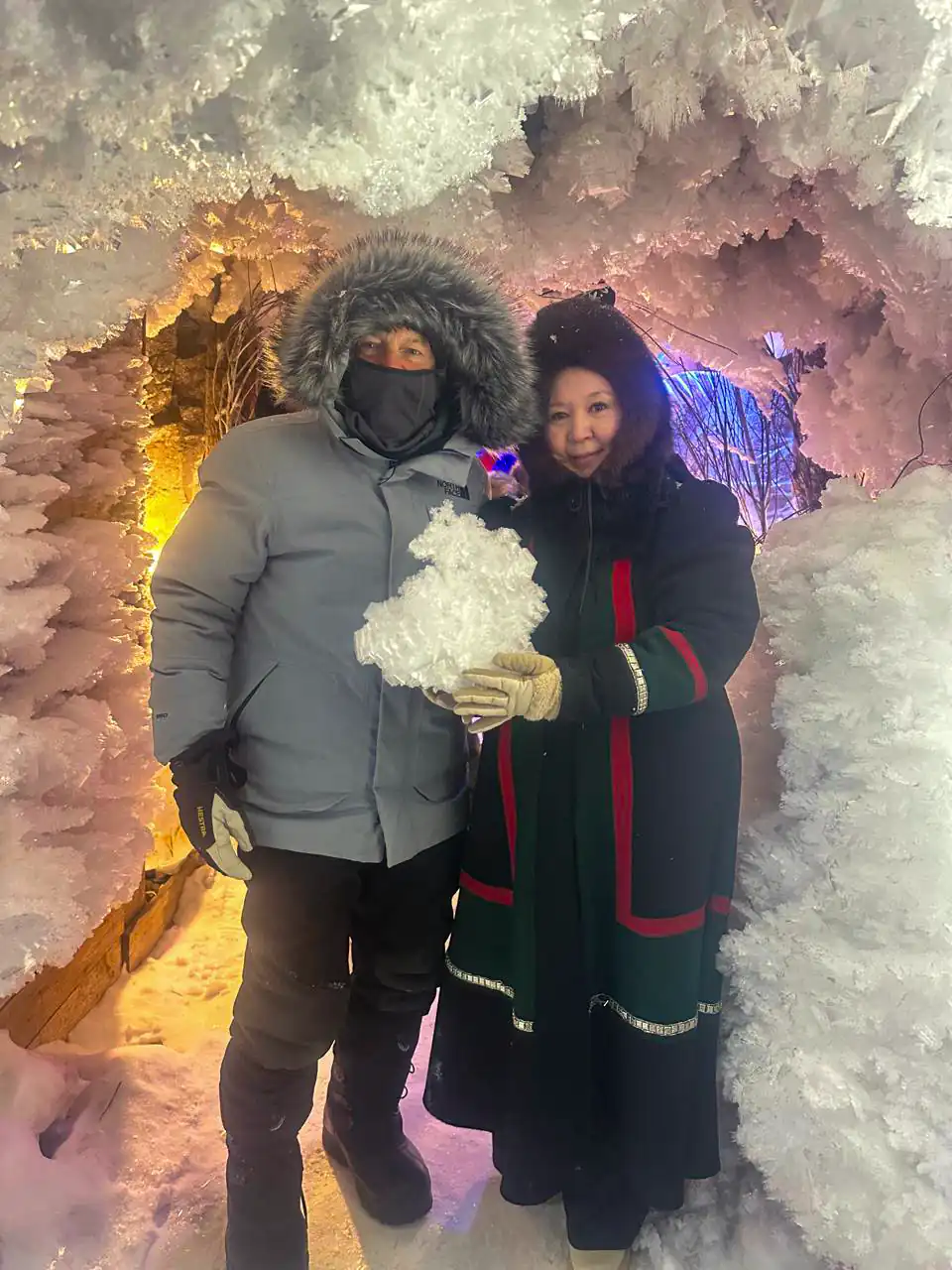
When we arrived in Oymyakon, the temperature read −51°C (−59.8°F). And that was at noon.
Few human beings have felt cold like this. The air becomes aggressive when you breathe it. The vapor from your breath freezes immediately. Eyelashes become covered in ice within seconds. Phones die within minutes.
Only about three hundred people live in the village. The streets are practically empty. Everything moves at a slow pace, determined by the climate.

Life on permafrost
We stayed at a local family's home, an experience that allows you to understand how life continues even in conditions that would seem incompatible with human existence.
The entire region sits on permafrost, a layer of permanently frozen soil that extends to great depth. Even when the surface may thaw slightly in summer, the subsoil remains solid as frozen rock. This condition determines how houses are built, how roads are installed, and practically all the infrastructure in the region.
The Keeper of the Cold
One of the most curious symbols of the place is the figure of the Keeper of the Cold, a character from local folklore who, according to tradition, is the guardian of Yakutia's cold.
We also visited the monument marking the point where the lowest temperature was recorded. There we took a photo blowing frozen air in front of the monument, watching how the vapor froze almost immediately in the air.


Morning walks at −50°C
Something that deeply puzzled our guides was my morning routine. Every morning I would go out walking in Oymyakon, at −50°C. The guides were genuinely surprised. They didn't understand why anyone would do something like that voluntarily.
But there's something deeply stimulating about walking in a place where nature absolutely dominates everything.
It's estimated that fewer than two thousand Westerners have visited Oymyakon. That gives the place a particular mystique. Many people have heard of it, but very few have experienced what it means to be there.
The eventful return
The last night in Yakutsk we went out with the group and when I woke up at five in the morning we realized our flight to Moscow had been canceled.
I grabbed my backpack and ran to the airport with a companion from the group and miraculously managed to get seats on an S7 Airlines flight. In Russia almost no one speaks English and, due to international sanctions, many things can only be paid for in cash.
Luckily I had enough rubles to pay for my ticket and hers. My suitcase, however, was left forgotten at the hotel. The rest of the group had to spend an additional twenty-four hours in Yakutsk.


An untameable place
Now, sitting on this plane crossing the Atlantic, I think about how extraordinary it was to have been there.
Oymyakon is not simply a cold point on the map. It's one of those places where the planet still feels untameable. Where nature sets the rules and human beings barely manage to adapt.
A remote, mysterious, and extreme place.
And precisely for that reason, it's worth going.
Gallery

